MLB replay plan: Don’t forget fan
Oakland slugger Jose Canseco might have lost some of his appeal to A’s fans by Aug. 31, 1992, following some off-field incidents and a controversy when he apparently upset teammates by leaving the clubhouse while the game was still going after coming out with an ailing back. Still, despite a year in which his numbers had fallen after a 44-home run outburst in 1991, few would do a concession run if he was coming up to bat. Canseco was in the lineup that night, and took his position in the outfield as the crowd of 25,442 settled into their seats to watch their A’s, who held a comfortable 7-1/2 game lead over Minnesota. Canseco, batting third, was in the on-deck circle when manager Tony LaRussa called him back to the dugout on orders of general manger Sandy Alderson. The trade deadline was just hours away, and the A’s had closed a deal sending Canseco to the Texas Rangers for outfielder Ruben Sierra and three others. All of us who there that night looked on in bewilderment as suddenly pinch-hitter Lance Blankenship was walking up to home plate. We surmised that Canseco must have had some injury or perhaps the flu which caused him to be lifted. Three hours later, after we got into our car and turned on the post-game on the radio, we learned that Canseco had been traded. No announcement on the PA, no message on mis-named Message Board.
I thought of that incredible disrespect shown to the paying customers that night as I looked over reports recently about major league baseball planning to expand the use of instant replay to get the calls correct. I read how it is very important for MLB not to delay the game too much, But I didn’t read anything about showing all the replay angles to the paying customers up on the big screens that ballparks have these days. Nor did I hear that baseball was going to borrow a page out of the NFL replay protocol, and have the chief umpire announce to the fans specifically about the call on the field and what is being challenged. This will not always be obvious. Suppose a batter hits a line drive to center, and the centerfielder apparently traps the ball, and then throws home and the runner is called safe on a close play. The manager for the team in the field could challenge that the ball was actually caught or that the runner was out. If you are in the stands, how would know? Sure, fans in the stands have a better chance to check out replays these days than in 1992 because of mobile devices which might give them a TV feed. However, the fan who puts down all the money to be at the park should not face the possibility of missing out on perhaps the most crucial moment of the game. And what would be the rationale not to show the replays on the big board at the stadiums? Fear that fans would riot over a bad call? There have been plenty of examples of bad calls, and so far no riots.
My big question about the state of umpiring: Are today’s umpires making more bad calls than the ones in, let’s say, the 1960s? Or has umpiring simply gotten worse as TV camera work has gotten much more sophisticated. I remember growing up watching baseball umpired by legends such as Al Barlick and Augie Donatelli. But I can’t really say with conviction that either of them might have their bad calls exposed more often these days with the zoomed-in looks we get on TV. The bottom line is that some form of replay is needed in baseball, though the proposal might still have some holes.
First, Bud Selig needs to buy all the managers a TV for Christmas. We can’t expect a manager in a dugout to get a very clear view of any close play. Just think how many times you’ve seen a manager spring from the dugout toward the umpire absolutely sure about what he just saw, and while he’s screaming and kicking dirt, a TV replay confirms the umpire was clearly correct. It would be a joke to pit the manager, with his bad vantage point and his one potentially make-or-break challenge in the first six innings, vs. some umpiring panel surrounded by more state-of-the-art TVs than an appliance store showroom. This one challenge is far too important. If the whole idea is to get it right, give the manager the tools he needs to see a replay or two so can use his challenge wisely to achieve what the MLB says it is trying to achieve.
What happens if MLB bans dugout TV? Then the manager must add a new position to his staff. Call him the replay coach. He should be one of the fastest runners in the organization, with plenty of baseball savvy to boot. His job would be to watch the game on TV in the clubhouse. If there’s a play that looks like a winning challenge, the replay coach would need to sprint down the corridor to the dugout to advise the manager whether he should go for the reversal.
I still feel like baseball needs to go back into a room, and go over this one more time. If the goal is to get it right, why even involve the manager? Why not put these calls into the hands of the new elite umpire with all the replays right there? They could be hooked up to one of the on-the-field umps and buzz them if another look is warranted. The plate umpire could stall for time by taking out that little broom he carries, and dust off home plate like he does when he’s buying time for a catcher who gets winged by a foul tip.
I’m still bothered that whatever new replay system is put in place, it might end the baseball tradition of the rhubarb. “Rhubarb,” by the way, was one of the earliest baseball words I learned as a seven-year-old fan. It made me a better speller because I could see that the “h” seemed totally unnecessary, but alerted me that there were a whole batch of other words that did similar things to trick you. I’d miss the manager/player-umpire rhubarb. My favorite rhubarb came during a game at Candlestick Park in the early 1960s when Pittsburgh catcher Smoky Burgess, apparently still fuming over a call in the first game of a doubleheader, got tossed out of the second game before it even began. Since this tradition is so important, perhaps MLB should allow each team to have one representative in the room of the elite umpire crew with all the TVs, and if he disagreed with their interpretation of the replay, he could charge them and go jawbone to jawbone. And they could show it to the paying customer, as a way to make up for that insult to A’s fans on the infamous night when Jose Canseco mysteriously went MIA.
L.A. regains attendance edge over S.F.
The Giants’ World Series championship team of 1954 outdrew the Dodgers at home by 134,000. That moment of one-upmanship over their rivals faded quickly. The Dodgers went on to lead the Giants in home attendance from 1955 through 1999. Brooklyn, in fact, had proven to the most popular team by the time the two clubs headed west in 1958. The Dodgers outdrew the Giants 16 of the last 19 years on the East Coast. Before then, Giants’ fans dominated, as New York led the Brooklyn in attendance in 43 of 46 years from 1893 through 1938. Brooklyn was the first to top one million in attendance, drawing 1,097,329 in 1930. New York cracked the one million mark for the first time in 1945.
The battle of the gate was never a fair fight on the West Coast through 1999. In the first two years, the Giants played at Seals Stadium with a capacity of about 23,000, while the Dodgers played in the 90,000-plus seat Memorial Coliseum. The much-maligned Candlestick Park, which opened in 1960, was no match for Dodger Stadium, which opened in 1962. The Giants had a 10-year streak from 1968 to 1977 where they drew above one million just one year. The rock-bottom season was 1974, when only 519,987 showed up. The Dodgers had their worst Los Angeles attendance year, drawing just 1.5 million in 1968, largely due to the dreary post-Koufax era.
The opening of then-Pacific Bell Park in 2000 made it a whole new ballgame. For the first time since 1954, the Giants drew more fans than the Dodgers with their first-ever three-million plus total. The Giants went on to top the Dodgers at the gate for the next three years. The Dodgers regained the attendance mantle with their division-winning team of 2004, and maintained their attendance lead through the 2010 season. Giants’ fans, lifted by the 2010 title, grabbed back the attendance advantage in 2011 and 2012. The 2011 season, one of the most chaotic in the storied Dodgers franchise because of the financial and ownership uncertainty that discouraged past loyal fans, dropped Dodger Stadium attendance below three million for the first time since the post-strike year of 1995.
Fans’ confidence in the new ownership, the team’s incredible surge, and improvements to Dodger Stadium have boosted attendance to a league-leading total averaging above 45,000 in 2013. The Giants, with a long streak of sellouts, can’t do much to compete with that number, since their park holds just above 41,000.
Best rookie: McCovey or Puig?
Few players have had such a start as the Giants’ Willie McCovey. The 21-year-old first baseman introduced himself to the baseball world with a two-single, two-triple four-for-four day against the Phillies and future Hall of Fame pitcher Robin Roberts on July 30, 1959. In 52 games, McCovey was 68 for 192 with 38 RBIs, nine doubles, five triples and 13 home runs. He had 22 walks and 35 strikeouts. His OBP was .429 and his slugging average was .656.
Puig’s debut on June 3 was respectable, but not remarkable when compared to McCovey, as the Dodgers’ 22-year-old outfielder had two singles off Eric Stults of San Diego in four at bats. Puig has put up numbers that rival or surpass McCovey since then, although he is at an obvious advantage because he is playing more games. After 60 games, Puig was 86 for 229, with 26 RBIs, 14 doubles, two triples and 11 home runs. He had 23 walks and 60 strikeouts. His OBP was .444 and his slugging average was .598. Puig has come down a bit since his torrid start, hitting just .139 over one nine-game stretch.
McCovey’s numbers weren’t enough to carry the Giants. He debuted while the Giants were in second place, a half-game behind the Dodgers. The Giants went just 28-26 the rest of the way, and finished third. The Dodgers went on to win the NL flag and the World Series. The Dodgers were 23-32, 8-1/2 games out and in fifth place when Puig played his first game. Since then, the Dodgers have gone 53-21, and taken a 9-game lead.
McCovey was a unanimous selection as rookie of the year. If Puig had debuted that same season, would he have beaten McCovey out of that honor? Another thing to consider: Would the voters have been influenced negatively by Puig’s series of miscues and tantrums? The young phenom has showed up late on a game day, missed cutoff men, got carelessly picked off, displayed an almost out-of-control anger over an umpire’s call and failed to run hard out of the box on a long fly because he assumed the ball was leaving the park. Those are traits that didn’t seem to part of McCovey’s game. In a night game at Candlestick Park in 1960, McCovey launched a high, but routine fly to Dodgers outfielder Duke Snider, who lost it in the thick San Francisco fog. McCovey, who had to be running hard from the outset, ended up at third. It would be interesting to see if Puig would have gotten that far.
Can Giants be spoilers?

Giants nightmare: Brian Wilson clincher at AT&T
The Giants and Dodgers play seven times in September – four in Los Angeles Sept. 12-15, and three in San Francisco Sept. 24-26. The Giants clearly won’t be a contender, but if Arizona can stay in the race, the Giants could have a chance to play the spoiler role.
Dodgers in fast company
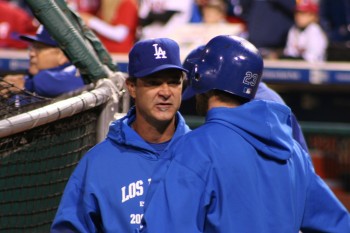
Don Mattingly still faces challenges.
The Dodgers’ victory over Philadelphia Aug. 17 put them in pretty fast baseball company. The club tied the 1941 New York Yankees and 1942 St. Louis Cardinals for the best 50-game stretch since 1900 with a 42-8 mark. The 1951 New York Giants have to be part of the equation, having won 39 of their last 47 games. Interestingly, the Dodgers succumbed to all three teams. The Cardinals trailed the Dodgers by 10 games on Aug. 5. The 50-game tear began Aug. 9, allowing the Cardinals to edge the Dodgers for the pennant with a 106-48 record. St. Louis, an aggressive base-running team which led the league in runs, doubles and triples, also relied on dominant pitching as it allowed just 29 runs in the last 17 games of the season. The Cardinals defeated the Yankees in five games to win the World Series.
 Joe Konte